
Lebanon City Directory Collections
Lebanon has several practical routes to historical city directory material, but no official source inspected here lists a complete local run. The strongest online lead is the U.S. City Directories collection, which covers 1822 through 1995 nationally and includes evidence of a Lebanon entry from 1927. The Lebanon-Wilson County Public Library, Wilson County Archives, Tennessee State Library and Archives, and Library of Congress guides make up the in-person and catalog fallback chain. Each source answers a different question, so keep the edition title and page citation with every finding.
| Collection lead | Years or local evidence | Where held | How to reach it |
|---|---|---|---|
| U.S. City Directories | 1822–1995 national collection; Lebanon 1927 evidence | Online collection and library access | Browse by state, city, and year; image access can require login |
| Lebanon directory and telephone books | Exact shelf run not published | Lebanon-Wilson County Public Library | Ask the reference desk for directories and reverse books |
| Address and telephone directory leads | Lebanon is named in the Tennessee guide | Library of Congress | Catalog and local-history guidance |
| County historical series | Early local runs vary by record type | Wilson County Archives and TSLA | Catalog, staff help, and archival holdings |
A city directory is evidence from one edition, not a continuous roll of all Lebanon residents. Search the library, archive, and catalog layers when an expected year is absent. The library is also the practical place to ask whether a reverse or criss-cross volume, newspaper reel, or licensed genealogy database fills the gap.
Lebanon City Directory Shelf Help
The Lebanon-Wilson County Public Library is at 108 South Hatton Avenue and is a useful first stop when the web does not show a full directory inventory. Its listed hours are Monday, Tuesday, and Thursday from 8 a.m. to 7 p.m.; Wednesday, Friday, and Saturday from 8 a.m. to 5 p.m.; and Sunday closed. The library’s phone is 615-444-0632. Ask specifically for Lebanon directories, telephone books, reverse or criss-cross volumes, Lebanon Democrat material, Cumberland yearbooks, obituary sources, and licensed genealogy access.
The library’s public gateway is shown below. It is a reference starting point rather than proof that every historical shelf item is digitized. Bring surname variants, a rough neighborhood, a date range, and the record type. A request for a named series is far easier for staff to act on than a request for every Lebanon resident.

The screenshot helps identify the current library gateway before a visit or call. Confirm availability of a particular volume with staff because the website does not publish a complete directory, newspaper, obituary, or reverse-directory list.
Wilson County Archives is another essential channel for older county series. Its holdings include marriages, court records, wills, bonds, guardianships, schools, elections, births and deaths, deeds, and county minutes. Those sources can test a city directory spelling or household claim when a volume does not survive.
Note: Record the edition, publisher, page, and whether the entry came from an image or OCR result before drawing a household conclusion.
Lebanon 1927 City Directory Evidence
The confirmed local lead is a Lebanon 1927 entry within the digitized national city directory collection. That is a useful starting date, not evidence of a complete Lebanon publisher sequence. The unattended collection review did not yield an image-level local entry or a complete masthead, so no publisher, person, or missing-year claim should be invented from it. Search by Tennessee, Lebanon, and year, then open the page image where access permits.
The digitized directory collection offers state, city, year, and OCR-oriented browsing. OCR is a finding aid. It can miss initials, punctuation, faint print, and abbreviated street names. Browse a street page or alphabetical image when a surname search fails, and retain the scan rather than relying only on the extracted text.
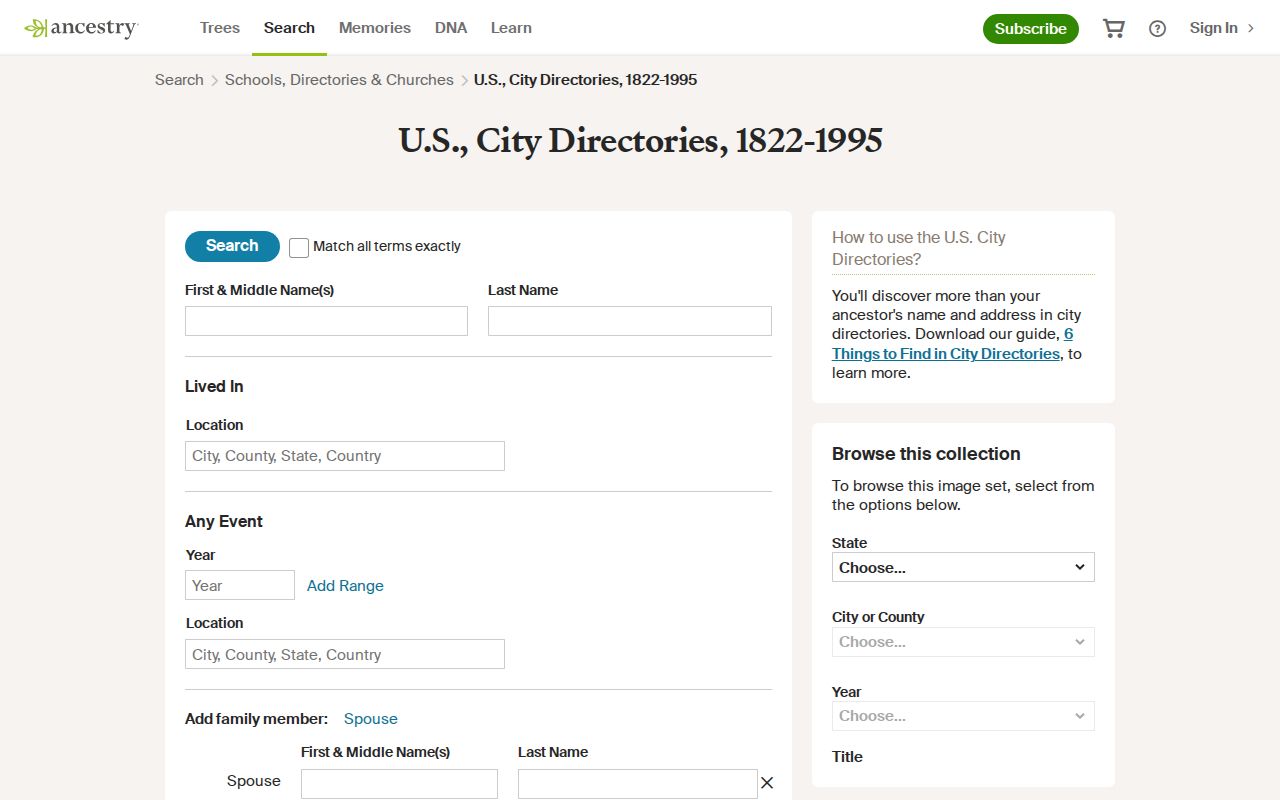
The collection interface illustrates why an image check matters: a browse result and an entry scan are not the same thing. The local 1927 evidence should be paired with the edition and page before it is used as a historical address lead.
Read a Lebanon City Directory Entry
A directory entry usually compresses a household into a short line. Start with the page heading and abbreviation key, then transcribe the name exactly as printed. Typical entries can include a surname and given name, spouse or household notation in parentheses, street address, an owner or renter mark, occupation or affiliation, business listing, telephone, and widow notation. These marks describe that edition, not a lifetime fact or a modern address.
| Name form | Capture initials, suffixes, punctuation, and surname spelling exactly as printed. |
|---|---|
| Household wording | A spouse or other household name may appear in parentheses and can reveal a second search term. |
| Street line | Keep the house number, street spelling, and cross-street context when shown. |
| Directory marks | An h/r-style owner or renter notation is the publication’s shorthand for that one edition. |
| Other clues | Occupation, telephone, business line, or widow notation can guide a newspaper, census, or probate search. |
- Criss-cross directory
- A directory section arranged by address or street rather than surname, useful for locating the listed occupant of a historical address.
- Householder index
- An alphabetical entry point that may name the person under whom a household was listed.
- Abbreviation key
- The volume’s legend for shortened words and marks; photograph it before interpreting h, r, wid, or similar notation.
- OCR
- Machine-read text from a scan. It helps locate a page but must be checked against the image.
Do not turn an owner mark into title evidence. A later deed or assessor record may show a different owner, and a titled owner can have a separate mailing address. Directory entries are strongest when they are kept alongside their exact page image and compared with a second independent source.
Lebanon City Directory Street Clues
Criss-cross and reverse-directory books are valuable because they turn an old Lebanon address back into a listed name. The library’s exact run is not published, so ask the reference desk whether a particular year or nearby volume exists. A criss-cross result reflects the book’s date and its listing rules. It is not a current household list, and it should not be substituted for the modern parcel method.
For a house-history question, retain the old number, street spelling, cross street, and any prior street name. The Lebanon street address directory is the better route for current parcel and map work after a historical address has been identified. That division matters because modern county records distinguish owner, tax mailing, legal description, and situs address.
Note: A missing address can reflect a changed number, a new subdivision, an abbreviated street, or an edition gap rather than a missing household.
Lebanon City Directory Companions
Cumberland University Phoenix yearbooks add another Lebanon name trail. The FamilySearch catalog identifies issues from 1896, 1903, 1904, 1908, 1923, and 1927 through 1932. They can show class, organization, and alumni clues. A yearbook appearance shows an institutional connection for that date, not a present address or a full household.
TSLA’s Wilson material adds local histories, African American records, People of Wilson County, newspapers, cemetery and church records, deed books, tax lists, and city and county minutes. Church and school material can help with married names, children, ministers, teachers, and civic roles. Pair a result with a directory, marriage record, census, obituary, or deed before treating two same-name references as one person.
Lebanon City Directory Time Gaps
Historical research in Lebanon needs a timeline because record survival is uneven. Wilson County formed in 1799, and Tennessee State Library and Archives records the 1881 courthouse fire. A missing original does not prove that a family was absent. County minutes, City Hall minutes, wills, marriages, court and probate files, deeds, tax lists, newspapers, and archival indexes can provide a reconstructed trail.
- 1799: Wilson County formed from Sumner County, establishing the county setting for early records.
- 1809–1929: TSLA lists three runs of Lebanon City Hall minutes, with gaps between the runs.
- 1881: The courthouse fire complicates assumptions about original early series.
- 1927: Digitized collection evidence confirms at least one Lebanon city directory entry.
- 1950: This is the latest public federal household census under the 72-year release rule.
The safest practice is to describe the source actually found, its date, and its limits. A directory gap is a research task for the library, Archives, TSLA, FamilySearch, or a targeted record request, not a reason to fill in people from memory.
Trace Lebanon City Directory Households
Follow a household through editions one year at a time. Begin with a known address or the first appearance of a name, then capture every spelling, initial, street number, and notation. Move backward and forward through nearby editions, allowing for widow entries, OCR mistakes, and an address written in a different form. Pairing a directory with the next public census gives a better picture than either source alone.
- Find the person or address in one dated city directory and save the image citation.
- Search the prior and later editions with initials, surname variants, and spouse or widow wording.
- Check a criss-cross section when available to compare the name with the historical address.
- Pair a 1927 entry with the 1930 census, then use 1940 or 1950 for later public household context.
- Use WilsonDeeds legal descriptions, marriages, probate, cemetery sources, or newspapers to explain a move, death, or surname change.
A directory occupant may not own the parcel, and a deed owner may never appear as an occupant. For a modern name confirmation after a historical lead, use a focused Lebanon resident lookup with two independent identifiers rather than treating one old entry as current proof.
Lebanon City Directory Fallbacks
When a surname is not in a digitized result, start with the library reference desk, then Wilson County Archives, TSLA’s county fact sheet and catalog, the FamilySearch catalog or image viewer, the city-directory collection, and Library of Congress local-history guidance. State the surname variants, approximate Lebanon neighborhood, date range, and record type. That sequence reaches both physical shelves and specialized county sources without pretending that one online index is complete.
Newspapers listed by TSLA from February 1839 through May 1916, plus City Hall minutes and marriage material, can place a name near a street or civic event when a city directory is silent. Cedar Grove Cemetery, established in 1846, can be an endpoint, though no official online interment name search was located. Ask the appropriate custodian for existing records and expect some gaps.